

Search Videos and More

Asthma in 2023: Time to get SMART finally?
Dr. James Krings, MD, MSCI discusses the latest guidelines and recommended care for Asthma in 2023.
SGLT-2 inhibitors in Chronic Kidney Disease
Reena Gurung, MD reviews some of the therapeutic choices and landmark trials for kidney disease. She also shares common complications encountered and how to mitigate risks.
Not all that Itches is Yeast: Vulvovaginitis in the Pediatric & Adolescent Patient
Dr. Maggie Dwiggins, MD, MS share techniques for a proper exam, how to diagnose common vulvar disorders and how to adequately treat vulvovaginitis.
Multiple Sclerosis: Symptoms, Management and the Role of Primary Care
Dr. Salim Chahin, MD, MSCE provides a thorough overview of MS and the role that primary care plays in MS.
Abnormal Uterine Bleeding: A Review of Evaluation, Diagnosis, and Management
Dr. Aneesh Chawla, MD, MS walks through the causes, diagnostics, evaluation and management of abnormal uterine bleeding.
2024 The Road to HIGHLY RELIABLE CARE is Paved with Thoughtful Processes and Purposeful Performance
How do health care professionals and organizations seize opportunities in the most efficient ways possible to reach and sustain high reliability?
The Fetal Care Center at Barnes-Jewish Hospital and St. Louis Children’s Successfully Performs its First Fetoscopic MMC Repair Surgery

The Fetal Care Center at Barnes-Jewish Hospital and St. Louis Children’s Successfully Performs its First Fetoscopic MMC Repair Surgery

Making Waves - Barnes-Jewish Hospital first to offer high intensity focused ultrasound for patients with ET
Barnes-Jewish Hospital, in partnership with Washington University Physicians, is among the highest-volume treatment facilities for movement disorders in the U.S.
Multidisciplinary Limb Preservation Program Saves Steps to Help Save Limbs
The Washington University Limb Preservation Program was established to connect patients facing amputation with all the medical specialists they will need to save their limb, in the shortest amount of time.
Joint Preservation Surgery Shows Promise in Young Adults with Hip Dysplasia
Periacetabular osteotomy (PAO) surgery corrects the deformed hip socket dysplastic to increase contact between the ball and socket, thereby reducing pain and improving stability and function.
Endometriosis and Infertility: Sundry Treatment Aspects
For women who have endometriosis, the two most common symptoms are pelvic pain and infertility. Specialists at the Fertility & Reproductive Medicine Center have decades of experience in diagnosing and successfully treating women with endometriosis to preserve or restore fertility.
Operational Improvement Projects 2023
This session explores three local projects: one each from St. Louis Children's Hospital, Barnes-Jewish Hospital and Washington University School of Medicine.
Brain Based Leadership Strategies for High Reliability
This session covers techniques to improve the resiliency and effectiveness of team leadership and teamwork, and identifies the effects of cognitive bias in leadership decision making.
There is an “I” in Team: Maximizing Your Contributions to Promote Team Success
Teams that successfully drive quality and safety outcomes depend on every team member to “choose” to follow and collaborate with others.
2023 Patient Safety & Quality Symposium – Tapping the Power of Collaboration by Embracing Shared Goals
Strengthening collaboration starts with developing a personal collaboration style that contributes to teamwork and culture, and then translating it to create more efficient collaboration techniques for teams and the organization.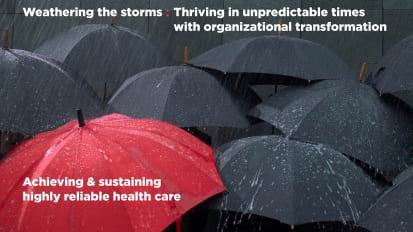
2022 Patient Safety & Quality Symposium – Weathering the Storms: Thriving in Unpredictable Times With Organizational Transformation
The 2022 Patient Safety & Quality Symposium incorporated the dual challenge of charting a course for organizational transformation while adapting to the unpredictable nature of health care. The discussion focused on the three elements of organizational transformation: people, process and technology, all of which are inextricably linked to successful outcomes within a highly reliable organization.
Operational Improvement Projects 2022
This session will cover the work of three local projects that correlate with today's theme: iTRUST (Identification & Tracking of Retained Ureteral Stents), Reducing Automated Dispensing Cabinet Overrides on a Labor & Delivery Unit:, and Leveraging Small Tests of Change to Improve Processes During a Behavioral Health Crisis
Mindfully Addressing High Reliability’s “Robust PI”: Multi-Level, Multi Organizational Enterprise-Wide Improvement
Elaine Huggins and Pamela Leonard share how Kaiser Permanente's National Program Office works the challenge of mindfully employing the High Reliability principles in multi-level, multi-organizational, enterprise-wide improvement that ties together the accountability of leadership commitment to no patient harm.
Re-designing for High Reliability – Lessons from Failures
In this presentation, Dr. Ryckman will share patient stories where system failures led to suboptimal outcomes and the work to improve using high reliability science. Examples come from inpatient, nursing and the operating room.
High Reliability Starts with Me
In this session, we'll explore our personal accountabilities with a specific focus on the behaviors that are the indispensable foundation for creating healthy cultures, using knowledge effectively, driving the learning system and transforming leadership.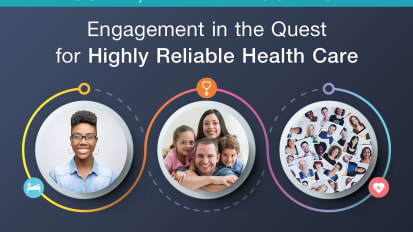
2021 Patient Safety & Quality Symposium – Personal, Team and Community Engagement in the Quest for Highly Reliable Health Care
This year’s theme focused on aligning the individual, team and community in the quest for highly reliable health care for all. In the presentations below, you will learn how to recognize the link between patient safety and burnout; cite strategies for team formation in a virtual world; and identify how to engage the community in patient safety and quality improvement efforts.
Team Overboard: How to Get Your Team Back in the Boat
Learn how to refocus team engagement, increase resilience and develop ways to get back on track.
The Future is Now: The Intersection Between Patient-Defined Healthcare Quality and the Social Determinants of Health
Understanding the connection between clinical outcomes and social determinants of health will help us redefine what quality means for each patient and how to improve it.
